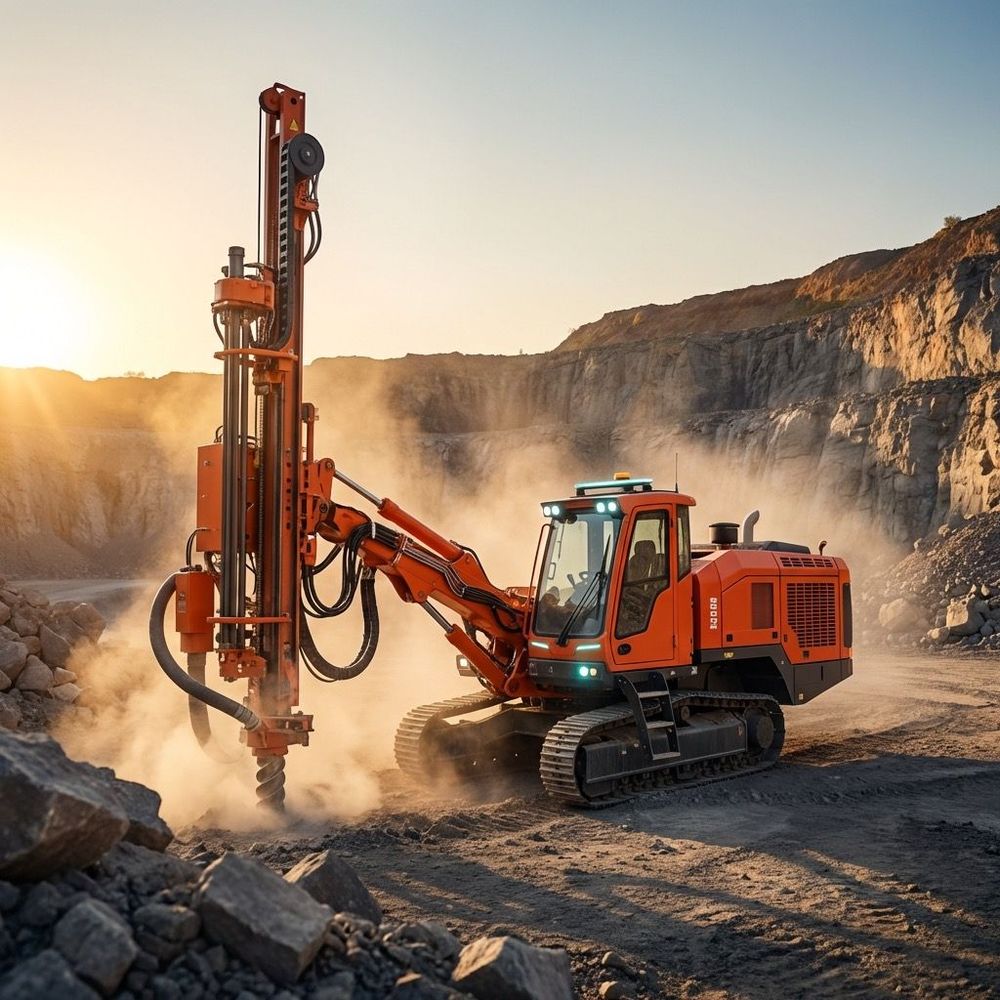
The sun goes down and the operators go home but the drills keep turning. How automation is unlocking millions in hidden value.
Imagine a quarry at 3 AM. It is pitch black. There are no floodlights on. There is nobody in the kantine drinking coffee. But out on the bench there is a hum. An orange machine is moving. It positions itself perfectly over a marked spot. The mast goes up. The steel spins. It drills a perfect hole to the exact depth required. It pulls out and moves to the next spot. And it does it all without a human being within ten miles.
This is the Sandvik Leopard DI650i equipped with AutoMine. And it is terrifyingly efficient.
The Consistency Problem:
- Humans are great but we are inconsistent.
- We get tired.
- We get distracted.
- We take breaks.
- We have good days and bad days.
A robot does not care. It does not get bored drilling the five thousandth hole of the week. It does not rush because it wants to go home. It just executes the plan with mathematical precision. Every hole is straight. Every hole is the right depth. Every hole is in the right place.
Why Precision Matters
In blasting precision is everything. If your holes are crooked or if the spacing is wrong your blast will be bad. You will get oversized rocks that clog up the crusher. Or you will get too many fines that are wasted product. By using an autonomous drill you guarantee that the pattern is drilled exactly as the engineer designed it. This leads to better fragmentation which leads to better crusher throughput which leads to more money.
The Safety Factor
Drilling is dangerous work. You are working near the edge of a high wall. There is dust. There is noise. By taking the operator out of the cab and putting them in a control room in the office you eliminate the risk. One operator can supervise three or four autonomous drills from the comfort of a chair with air conditioning and a coffee machine. They are effectively a fleet manager rather than a machine operator.
The Tech Stack
The Leopard DI650i is packed with sensors. It uses high precision GPS to know where it is to within a centimeter. It has cameras and lidar to see obstacles. If a rock falls in its path it stops and calls for help. It is smart enough to navigate the bench on its own.
This technology is not science fiction. It is running right now in mines in Australia and Canada and South Africa. And in 2025 it is becoming mainstream. The barrier to entry has dropped. You do not need to be a mega mine to afford this anymore. Even large quarries are starting to see the ROI.
The future of mining is not about bigger muscles. It is about bigger brains. And Sandvik is proving that the smartest operator might not be a person at all. It might be lines of code running on a ruggedized computer in an orange machine under the stars.