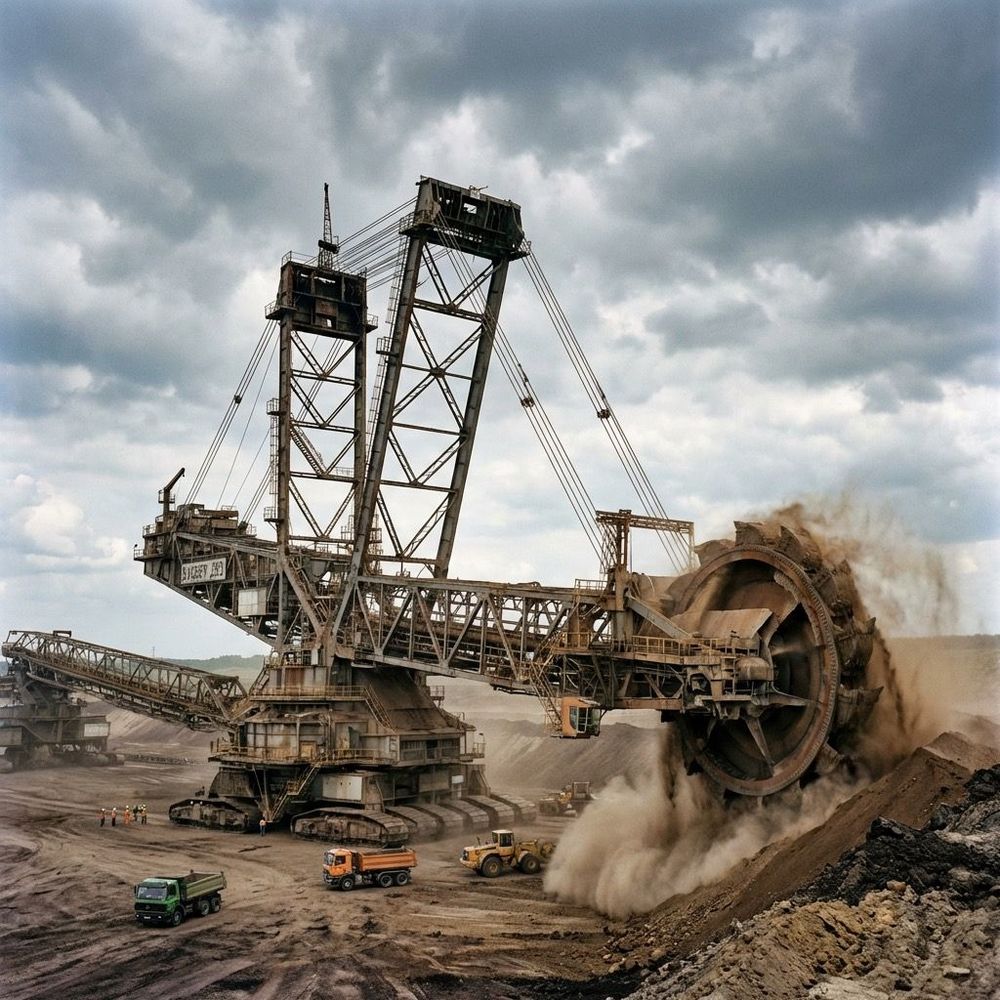
From German coal fields to NASA launch pads. We breakdown the engineering marvels that make a 400 tonne truck look like a toy car.
We often talk about "heavy" machinery in our line of work. We talk about fifty tonne excavators and forty tonne trucks. But there is a class of machine that exists on a completely different scale. These are not just machines. They are landships. They are mobile factories. They are the absolute pinnacle of what human engineering can achieve when the only goal is size and power.
We dove into the archives to look at the true heavyweights of the industry. The machines that you can see from space.
1. The Earth Eater: Bagger 293
You cannot start a list like this without the king. The Bagger 293 is not just an excavator. It is the tallest terrestrial vehicle in human history. Standing at ninety six meters tall, it is taller than the Statue of Liberty.
It operates in the German lignite mines and its job is simple but terrifying in scale. removing overburden.
The Wheel: The bucket wheel itself is over twenty one meters in diameter. That is height of an eight story building just for the cutting wheel.
The Capacity: It moves two hundred and forty thousand cubic meters of earth every single day. That is enough dirt to fill a football stadium to the roof.
The Power: It does not have an engine. It is plugged directly into the national grid and consumes as much electricity as a small city.
When you stand next to the Bagger 293 you feel the ground shake. It is a slow, rhythmic vibration that tells you this machine is not just moving dirt. It is reshaping the geography of the planet.
2. The Lying Eiffel Tower: F60 Conveyor Bridge
If the Bagger is the tall one the F60 is the long one. They call it the lying Eiffel Tower because it is five hundred and two meters long. That is significantly longer than the Eiffel Tower is tall.
It works in tandem with the bucket wheel excavators. It is essentially a massive, moving bridge that spans across the open pit mine. It takes the dirt from the extraction side and conveys it over the mine to the dumping side.
It moves: Despite being half a kilometer long it runs on rails.
It is heavy: Useable weight is over thirteen thousand tonnes.
It is fast (relatively): It can process nearly thirty thousand cubic meters of soil per hour.
3. The Rocket Mover: NASA Crawler Transporter
Most mining machines stay in the pit. But this one was built to go to the stars. The NASA Crawler Transporter is the largest self powered land vehicle in the world. It was built to carry the Saturn V rocket and later the Space Shuttle from the Vehicle Assembly Building to the launch pad.
It is unique because it has to be perfectly level. As it climbs the incline to the launch pad a hydraulic leveling system keeps the massive rocket vertical to within a fraction of a degree. It moves at a top speed of one mile per hour unloaded and burns gallons of diesel just to move a few feet. But without it we would never have walked on the moon.
4. The Tunnel King: Bertha
We usually look up at machines but sometimes the biggest ones are underground. Bertha was the world's largest tunnel boring machine built for the Alaskan Way Viaduct replacement in Seattle.
Diameter: Seventeen and a half meters wide. You could drive a four lane highway through the hole it makes.
Weight: Seven thousand tonnes.
Length: nearly one hundred meters long.
It is a factory that eats rock at the front and builds a concrete tunnel at the back. It is the ultimate subterranean beast.
The Future of Size
Are we going to build bigger? Probably. As we mine lower grade ores we need to move more material to get the same amount of metal. That means bigger trucks, bigger shovels, and bigger crushers. We are already seeing four hundred tonne autonomous trucks driving themselves in Australia.
But the Bagger 293 might hold the record for a long time. It represents an era of mega engineering that is hard to replicate. These machines are reminders that when humans decide to move the earth we do not use a shovel. We use monsters of steel and electricity that defy imagination.