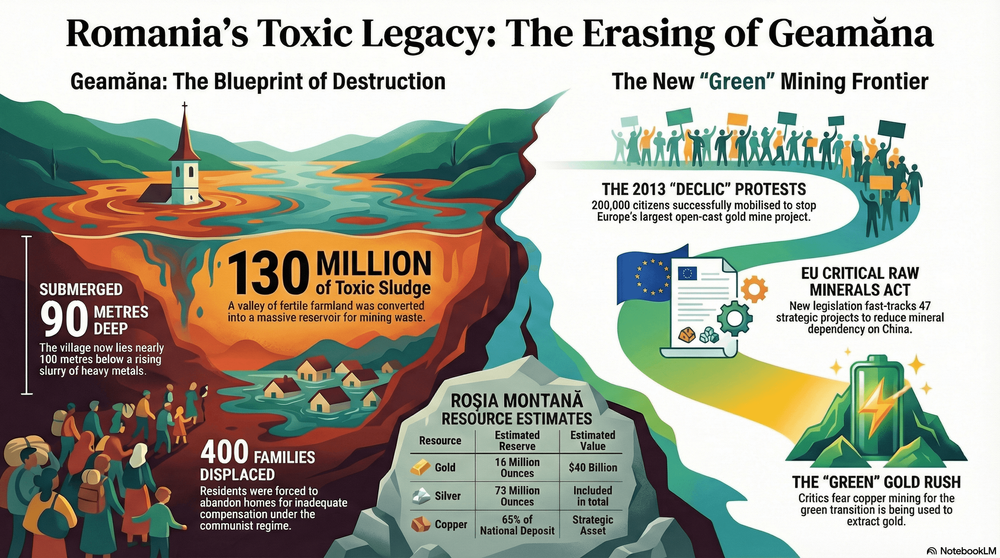
In the shadow of the Carpathian Mountains, a new alliance between mining giants and the European Union threatens to erase history for the sake of "Critical Minerals".
- Introduction: The Ghost of Geamana
The story begins with a visual that haunts these mountains: a church spire rising from a lake of toxic sludge. This is Geamana, a village drowned by waste from a copper mine under Ceausescu's regime. It stands as a silent, terrifying monument to the cost of unchecked industrial greed.
For years, we believed such horrors were relics of the past. But today, just miles away in the Rovina Valley, history is threatening to repeat itself. This time, however, it is not a communist dictator giving the orders. It is a Canadian mining corporation, EuroSun Mining, backed by the full strategic weight of the European Union.
- The New Gold Rush: "Critical Minerals"
Why is this happening now? The answer lies in the global pivot to renewable energy.
We are told that to save the planet, we must transition to electric power. This transition requires vast amounts of copper, lithium, and other "critical minerals."
The Problem: Currently, China dominates 90% of the refining industry for these minerals.
The Reaction: The EU, fearing dependency on China, passed the Critical Raw Materials Act of 2023. This legislation is designed to fast-track mining projects within Europe, bypassing local opposition to secure supply chains.
Suddenly, the gold and copper sitting beneath the Romanian mountains became a matter of "Continental Security."
- The Rovina Valley Project
EuroSun Mining holds the license for the Rovina Valley project, Europe's second-biggest gold and copper deposit. Their plan is massive. It involves vast open pits that will fundamentally alter the landscape.
While the company boasts that the project is "cyanide-free" and uses "dry-stack" tailings to minimize environmental risk, the local reality is far grimmer.
Displacement: Families who have lived on this land for generations face eviction.
Destruction: Ancient Roman mining galleries and unexcavated historical sites—part of the region's UNESCO World Heritage status—are at risk of being obliterated.
The Green Alibi: The company claims they are mining copper for the EU's green transition. Yet, mining executives admit that the project is heavily driven by the massive gold deposits found alongside the copper. Gold is not a critical mineral for green energy; it is a profit engine.
A "Green" Con Job?
The documentary raises a disturbing question: Is the "Green Transition" becoming a Trojan Horse for corporate exploitation?
The Romanian government and the EU have actively weakened legislation to make it easier for these companies to operate, stripping power from civil society and local NGOs. As one activist notes, "They found a great ally within the European Union that created weaker legislation."
We are destroying actual nature—forests, rivers, and communities—to extract the minerals needed to build the technology that is supposed to "save" nature.
- Conclusion
The sunken church of Geamana serves as a warning. When we prioritize industrial output over human life and heritage, the result is a toxic wasteland. Today, we risk creating new Geamanas across Europe, all under the banner of sustainability.
As the EU rushes to secure its supply chains, we must ask:
Are we saving the world, or are we just selling what's left of it to the highest bidder?