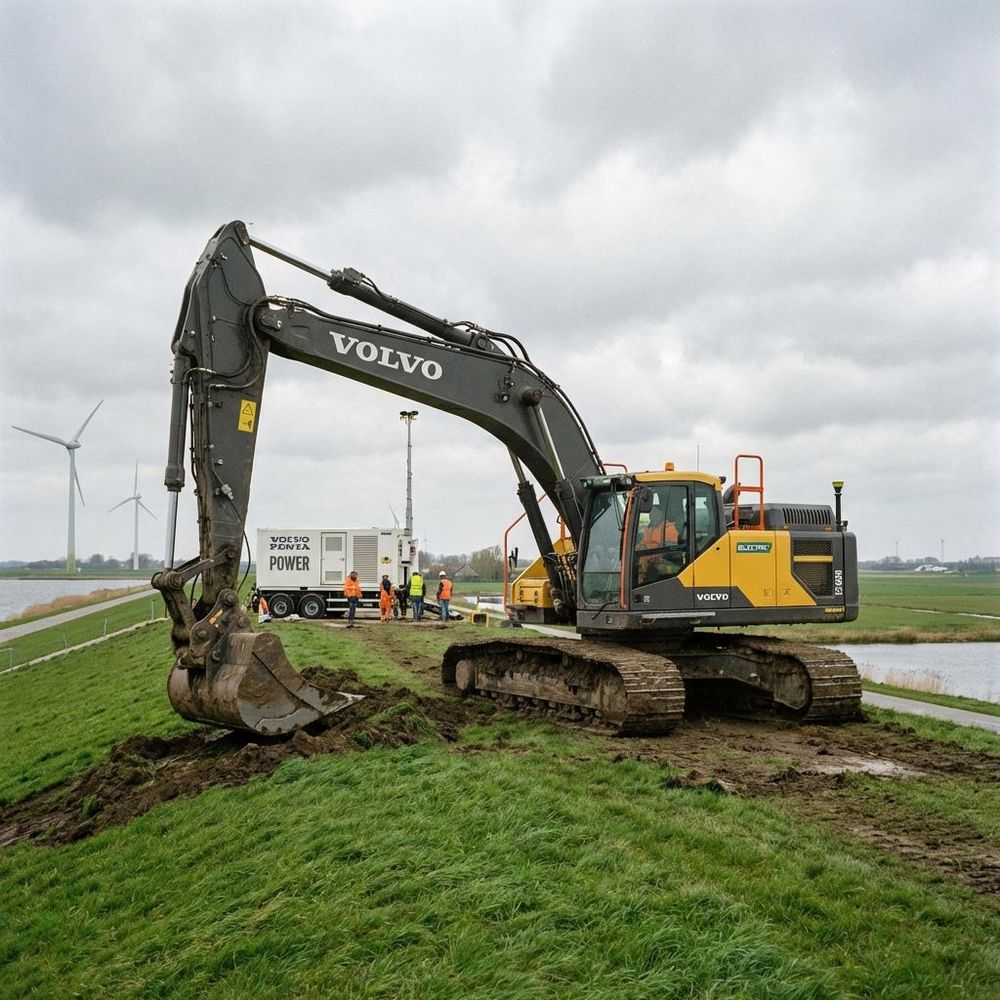
A Deep Dive Into The Dutch Dike Reinforcement Project That Changed The Rules
If you think "electric heavy machinery" is just a PR stunt for trade shows, you need to look at what is happening in the Netherlands right now. We are not talking about a 1.5-ton mini-digger landscaping a backyard. We are talking about 40-ton crawlers moving thousands of cubic meters of heavy Dutch clay, reinforcing critical flood defenses, without burning a single liter of diesel.
The Project: Sterke Lekdijk
The project is part of a massive dike reinforcement initiative. The Netherlands, fighting its eternal war against water, has mandated creating "emissions-free" construction sites. This isn't a suggestion; it is a tender requirement. The result is a heavy machinery ballet performed in almost total silence.
The Iron: Heavy Hitters Gone Electric
What makes this specific site revolutionary is the scale of the equipment. We are seeing converted units and factory prototypes that prove battery technology has graduated from "light duty" to "production class."
The 40-Ton Class: The workhorses are electric conversions of machines like the Doosan DX355 or Caterpillar 336. These beasts carry battery packs weighing tons, often swappable, mounted on the rear where the counterweight used to be.
Runtime Reality: The biggest question we get at OP Group is "How long does it last?" On this site, these machines are pulling 8-hour shifts. The secret? They aren't just plugging into a wall. They are part of a complex energy ecosystem.
The "Grid" Problem: Bringing the Power to the Mud
This is the most fascinating part of the video analysis. A construction site is effectively a desert when it comes to grid power. You can't just run an extension cord 20 kilometers from the nearest substation.
The solution? Mobile "Mega-Powerbanks".
Huge, containerized battery storage units are trucked onto the site. These containers are charged elsewhere (off-peak, green energy) and delivered like fuel tanks.
The Logistics Shift: Instead of a fuel truck driving around pumping diesel, a truck with a crane swaps empty battery boxes for full ones. It is a completely new logistical chain.
Fast Charging: The excavators plug into these containers for high-speed DC charging during lunch breaks, pushing 300kW+ into the machine's veins.
The Operator Experience: "I Can Hear The Birds"
Interviews with the operators reveal an unexpected benefit: comfort.
1. Silence: The deafening roar of a 6-cylinder diesel engine is gone. Operators communicate via radio without shouting. They can hear the bucket engaging the soil, giving them better tactile feedback.
2. Vibration: The constant low-frequency vibration of an idling diesel engine causes significant fatigue over a lifetime. That vibration is gone.
3. Torque: Electric motors provide instant torque. There is no revving up to get hydraulic pressure; the power is there the millisecond you touch the joystick.
Is This Scalable? The OP Group Take
At Overpower Machinery, we look at the numbers. Right now, this "emissions-free" privilege comes with a premium—often 2x to 3x the capital cost of the machine, plus the infrastructure.
However: Maintenance costs plummet. No oil changes, no fuel filters, no AdBlue systems, no DPF failures.
The Regulation Wave: What happens in the Netherlands usually drifts East. By 2026/2027, we expect similar "low emission zone" tenders to appear in Germany and Scandinavia.
Conclusion
The "Electric Dike" proves that the technology works. The machines are capable. The barrier is no longer engineering; it is infrastructure and cost. But if you want to see the future of our industry, watching a 40-ton excavator work in silence is a sight you won't forget.