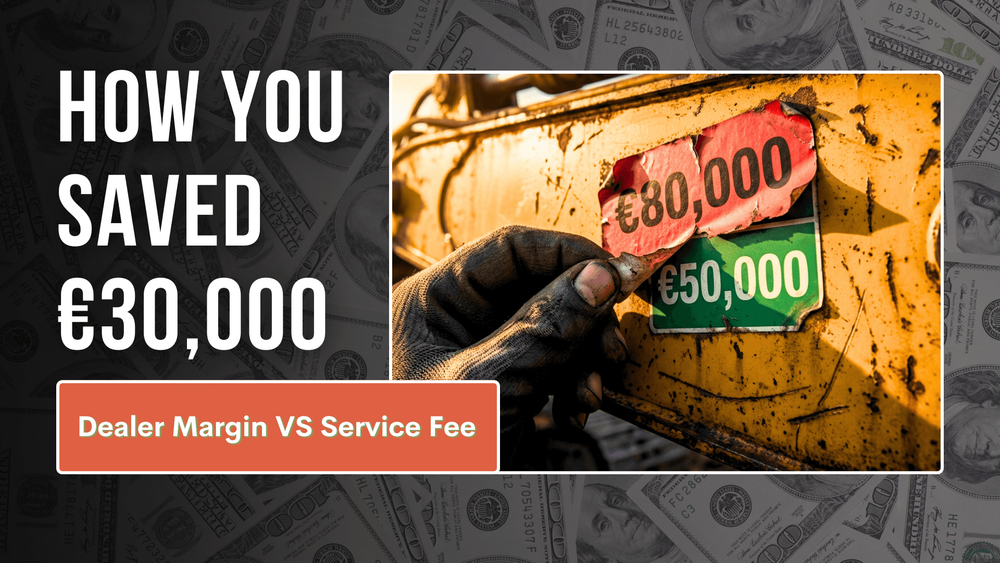
The Heavy Machinery Debate: Dealer Margins vs. Direct Access. Watch the full debate in the video.
The heavy machinery industry is one of the most capital-intensive sectors in the world, yet for decades, it has operated on a model of "blind trust." You need an excavator; you go to the local dealer on the edge of town, you haggle a bit, and you pay the invoice.
But recently, a heated debate has erupted in the industry. Is that traditional "safety" actually a financial hemorrhage?
We deep-dived into the conflict between the traditional Stock Dealer Model and the disruptive Service Partner Model (pioneered by Overpower Machinery). The findings were stark. For most mid-sized construction companies, the traditional model isn't just expensive—it's actively draining capital that could be used for growth.
Here is the breakdown of the "Debate" and why the smart money is moving to direct sourcing.
1. The Origin Myth: It All Comes from the Same Place
The first pillar of the Dealer's defense is uniqueness. When you walk onto a pristine lot and see a polished CAT 320 or a Liebherr 944, the implication is that this machine is "special."
The Reality: Almost all high-quality used heavy machinery in the European market originates from the same two sources:
Western Europe: Major auctions and fleet liquidations in Germany, France, and the Netherlands.
China: Massive state-level fleet turnovers.
The local dealer does not manufacture the machine. They simply have the logistics network to buy it from these sources, move it, mark it up, and park it. When you buy from a dealer, you aren't paying for a unique asset; you are paying for the friction of moving that asset from Point A to Point B.
2. The Price Anatomy: Where Does the €30,000 Go?
This is the most contentious point of the debate. Supporters of the dealer model argue that the markup covers "risk" and "convenience." But let's look at the math.
The Dealer "Black Box":
Source Price: €50,000 (at auction in France)
Dealer Price: €80,000 (on the lot in your country)
The Gap: €30,000
You never see the original invoice. You simply pay the €80k. That €30k gap covers the dealer's massive overhead: the lot rent, the sales team's commissions, the coffee machine, and the interest payments on their unsold inventory.
The Overpower "Glass Box": Overpower introduced the "Service Partner" model to break this black box.
Source Price: €50,000 (You see the real invoice)
Flat Fee: ~€3,000 - €5,000
You Pay: €53,000 - €55,000
The savings are not magic; they are structural. You stop funding the dealer's overhead and only pay for the execution of the deal.
3. The Mechanic's Trap: Conflict of Interest
"But what if it breaks?" This is the Dealer's trump card. We have our own mechanics.
But in the debate, we exposed a critical flaw in this reasoning: Incentive Structures.
Dealer Mechanic: Works for the seller. Their goal is to move inventory. Structurally, they are incentivized to perform "cosmetic" repairs—a fresh coat of paint or a quick patch—to get the machine sold. If they find a deep internal flaw, revealing it hurts their employer.
Independent Partner (Overpower): Works for you. Overpower uses independent verified partners whose only job is to find the truth. They don't care if you buy the machine or not; they get paid for the inspection.
The Verdict: Would you rather trust a mechanic paid to sell, or a mechanic paid to inspect? The smart money chooses independence.
4. The VAT Hack: The Bridge Over the Wall
Perhaps the most overlooked financial drain is the "VAT Trap."
In the standard model, buying locally means paying 20-25% VAT upfront. On an €80,000 machine, that’s an extra €16,000 to €20,000 of your cash locked up in government coffers for months until you reclaim it. That is "dead capital." It can't be used for fuel, wages, or new projects.
The Overpower Solution: By facilitating a Direct Foreign Order (Intra-Community Supply), the transaction legally qualifies for 0% VAT at the point of purchase.
Dealer Way: Pay €100k total -> Wait 3 months for €20k refund.
Overpower Way: Pay €55k total -> Keep €45k in your bank account today.
This massive difference in "Velocity of Money" allows companies to grow faster, bid on more jobs, and maintain healthier cash flow.
Conclusion: Paying for Friction vs. Paying for Truth
The debate concluded with a simple realization. The Dealer model isn't "evil"—it's just obsolete. It was built for a world before digital transparency, global logistics networks, and independent verification were easily accessible.
Today, paying a 30% premium for a handshake is a luxury most competitive businesses can't afford. You don't need a dealer to "sell" you a machine; you need a partner to tell you the truth about it and get it to your door.
Stop funding the margin. Start buying at the source.
Explore the Inventory at op-group.eu.